We designed the journey from taking in a single word to using it in speech, through the lens of language-based thinking.
Words3 tools for assembling thought
Multisensory learningMultidimensional experience rather than repetition
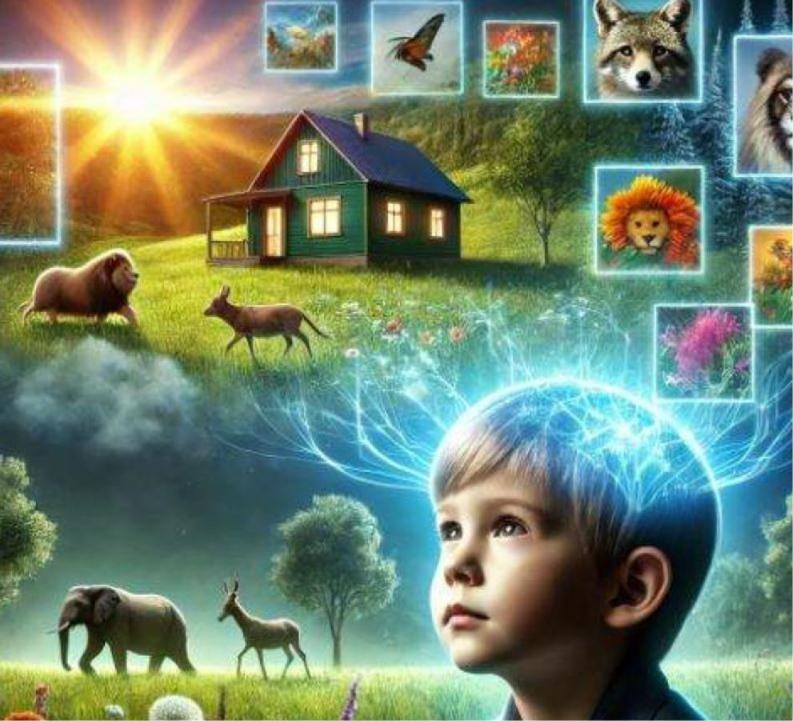
Mental imageryTurning sound into images in the mind
Spiral learningAn ascent that builds layers of understanding
OverlearningTurning effort into unconscious automaticity
RetellingTurning reception into active recreation
Generative speakingThe intelligence to create sentences independently
01
Words
Not labels, but three tools for creating thought, “All design begins with words.” Every design starts with words.
ConnectorA neurological hub binding scattered sensations, sound, color, taste, touch, and memory, into one, The more connections there are, the more instantly a needed word comes to mind.→ A dense, flexible semantic network
OrganizerA mental filter condensing disordered experience into one concept, “Apple!” instead of “Um… that… red… round… thing you eat…”→ Cognitive economy and logical organization
CreatorCognitive LEGO blocks for assembling new thoughts, Children combine a finite set of words to independently create expressions they have never heard.→ Infinite generative speaking
The magic of combination With 9 ingredients (apple, red, big, small, green, sweet, tree, my, favorite), children create “The big red apple”, “My favorite sweet green apple”, “Small apples from the tree”, and “I like big red apples!” As vocabulary grows, expression expands not as 1, 2, 3 but as 1, 2, 4, 8.
ALTIORA begins with a selection of 372 cognitive-tool words chosen for connectivity, frequency, and combinability. Words acquired through sound design hold the potential to create hundreds of millions of sentences.
02
Multisensory learning
Multidimensional experience instead of tedious repetition, “How many exposures does it take to internalize a tool for thought?” The mode of input determines the repetition required.
Reported exposures needed to learn word meaning
Listening only
15 exposures
Reading only
10 exposures
Text + sound + pictures
2 exposures
Listening only: Van Zeeland & Schmitt (2013) · Reading only: Pellicer-Sánchez & Schmitt (2010) · Text + sound + pictures: Bisson et al. (2014). These are separate studies with different adult learner populations. They do not support an exact multiplier comparison; they show a consistent tendency for the repetition needed to vary considerably with the mode of input.
Neurons that fire together wire together When brain regions processing sound, images, and movement activate together, they bind into a strong neural network (Hebb’s law).
Dual coding (Paivio) Information stored in both verbal and image codes has a safeguard: if one becomes unclear, the other supports retrieval.
The load on the brain actually decreases When an image immediately anchors meaning, the brain saves the energy of inferring from surrounding context and moves directly toward internalization.
Language the body remembers (embodied cognition) Learning “Climb” with an arm-reaching movement inscribes it in the motor cortex, so that later, hearing the word alone makes the brain simulate the movement.
Enjoyment calls up long-term memory Enjoyable multisensory activities stimulate the amygdala, which handles emotion, and signal the hippocampus: “This information matters; store it now.”
Children aged 36~72 months are multisensory beings who absorb the world through their whole bodies. Insisting on text or sound alone goes against the brain’s nature.”
03
Mental imagery
From a seeing brain to an imagining brain, “When a picture outside a child becomes an image within the mind, the child truly becomes a thinking being.”
Category
Seeing
Processing direction
Outside → Inside, Confirming information received through the eyes
The brain’s role
Receiving information
Cognitive state
Passive observation
Imagining
Processing direction
Inside → Outside, Retrieving memories as the brain draws its own “virtual reality”
The brain’s role
Retrieving and reconstructing information
Cognitive state
Active simulation
Two paths before a child’s brain
Traditional learning: the translation bottleneckLetter recognition→Korean translation→Meaning comprehension→Short-term memory→Forgetting
Imagery-based learning involves no translation. As soon as a sound is heard, an image lights up in the brain and the concept connects directly. This is the most direct cognitive expressway to acquiring English as a “2nd first language.”
Neuroscientific evidence: visual areas of the brain activate both during imagining and actual seeing, with a substantial proportion of active regions (about 2 out of 3) overlapping (Kosslyn et al., 2001). Self-generated images remain far longer than pictures shown by others, the generation effect (Slamecka & Graf, 1978).
04
Spiral learning
An ascending spiral, not a stationary circle, Why children’s eyes sparkle even after hearing the same story dozens of times: with every turn, the resolution of cognition increases.
A 4-level ascent on a spiral staircase: the “Animal” theme
Level 1
Acquiring symbols, Knowing names (Labeling)Mapping begins by attaching sound symbols to objects "Cat, Dog, Bird"
Level 2
Assigning attributes, Describing features (Description)Observing size and color and combining adjectives to make images specific "The cat is small. The dog is big."
Level 3
Dynamic connections, Expressing actions (Action & Relation)Connecting nouns and verbs to turn a still image into an event "The cat climbs. The dog runs."
Level 4
Cognitive ownership, Expressing one’s own thoughts (Generative)Combining personal feelings and logic, Language becomes a vessel for one’s own thinking "I like cats because they are soft."
The theme stays the same, but each turn uses the previous level as a stepping stone, preventing learning gaps. Children do not “study” grammar; they acquire the structure of language through experience.
The golden ratio of familiarity and novelty: the spiral’s slope changes with proficiency
Beginner 90 : 10
“An emotional stronghold builds ability.” When 90% of the content is familiar, the brain’s anxiety circuitry (the amygdala) settles and shifts from survival mode to learning mode. The unfamiliar 10% becomes discovery rather than threat.
Intermediate 80 : 20
“The threshold of discovering the pleasure of challenge.” Using familiar 80% clues to fill the remaining 20% gap develops analogical intelligence (desirable difficulties).
Advanced 70 : 30
“Creative variation and intellectual play.” On an internalized foundation, children reshape and combine new information, and generative thinking flourishes explosively.
■ Familiarity ■ Novelty. Familiarity provides intellectual confidence and a stable foundation; novelty provides appropriate tension and curiosity. In this balance, the child’s brain enters Flow, the optimal point between boredom and anxiety.
05
Overlearning
The final step that turns knowledge into talent, The only bridge across the deep divide between being able to do something (proficiency) and no longer needing to think about it (automaticity).
The brain learning to ride a bicycle: 3 stages of overlearning
Conscious overload Every brain region concentrates on pedal speed, handlebar angle, and center of gravity. Even a slight distraction causes a loss of balance.
Conscious proficiency “Oh, I can ride!” The rider no longer falls, but much of the brain remains occupied with control.
Unconscious automaticity The bicycle becomes part of the body. Spare mental capacity allows conversation with a friend and enjoyment of the scenery. A permanent talent that cannot be forgotten even if one tries
Language works the same way. Stage 2, speaking while thinking about vocabulary and grammar, is still only possession of knowledge. Only at stage 3 is the brain freed from “how to say it” to devote all its energy to “what to say.”
Category
Early learning: cerebral cortex
Completed automaticity: basal ganglia
Characteristics
The center of conscious thought and analysis
A storehouse of automated habits and instincts
In practice
“Which preposition was I supposed to use after this word?”
“I like apples!”, Instant, unconscious retrieval
Vulnerability
Slow, error-prone, and highly vulnerable to stress
Fast, accurate, and resilient under external pressure
Stress resilience When we are nervous, the emotional brain temporarily paralyzes the thinking brain. Yet information inscribed in the basal ganglia, the brain of habit, emerges like instinct even under tension and in unfamiliar environments.
Long-term potentiation (LTP) The discovery that repeated stimulation physically strengthens synaptic connections (Bliss & Lømo, 1973). Learning is not simply holding information; it is the physical transformation of neural circuitry.
Overlearning and retention A meta-analysis found that practice beyond reaching a criterion improves retention (Driskell et al., 1992). One exposure is a momentary spark, while meaningful repetition becomes a highway of memory.
Deliberate practice Experts are made not by repetition that merely fills time, but by practice that consciously pushes personal limits (Ericsson et al., 1993).
ALTIORA’s goalTo build “basal-ganglia English,” in which English flows fluently in any situation, beyond simply understanding the language.
06
Retelling
Telling an entire story, “Understanding lays the foundation of knowledge, and reconstruction completes the substance of intelligence.” From the intelligence of a consumer to that of a producer
A consumer’s response
“Um… the main character went on a trip. There were kangaroos too… It was fun.”
Impressions remain, but no structure. Information passes through the brain and flows away.
A producer’s response, Magic Carpet
“The magic carpet takes us to a big island. We see kangaroos and koalas. Good day! Welcome to Australia. We like to surf. Do you want to join us? We'll do it later! The carpet is waiting. The magic carpet takes us to a rainforest. We see jaguars and sloths. Olá! Welcome to Brazil. We like carnivals. … (continues to Switzerland, Vietnam, and Morocco) The magic carpet makes us tired. We are sleepy. We are going down. Good night.”
Reconstructing a whole book in one’s own language without losing its logical flow or details
3 conditions for complete internalization
Completeness Handling the entire structure from beginning to end while maintaining causal relationships. The whole map of a story, rather than fragments
Integrity Absorbing the original exhausted without simplifying it to tired, Retelling is a springboard that raises children’s language to the author’s level.
Agency While listening and reading bring information from outside to inside, retelling is active production that draws it from inside to outside.
What research says: the brain remembers most strongly not when information is put in, but when it is effortfully retrieved (the retrieval practice effect, Roediger & Karpicke, 2006). Retelling practice among kindergarten children improved understanding of story structure and sentence complexity (Morrow, 1985), while elementary students’ retelling improved memory for details and central themes (Gambrell et al., 1985; 1991).
7 gifted abilities developed together through retelling
Long-term memory formationThe effort of retrieval makes memory permanent
Understanding narrative structureBuilding a house of logic from fragments of information
Sequential thinkingConnecting chains of time and causality
Expanding working memorySimultaneous practice in holding, processing, and predicting
Language productionFrom receiving mode to transmitting mode
Self-monitoringMetacognition: the eyes that observe one’s own thinking
Confidence and achievement“I can tell a whole book from beginning to end!”
07
Generative speaking
Language is not a warehouse of stored phrases, but an engine of infinite creation (Language is an engine of infinite creation).
The moment children dismantle and reassemble several books to create a “4th story” found in none of the originals, they soar from passive readers to active authors.
Children adapt a narrative structure learned in one book, emotional expressions from another, and characters from yet another to their own situations, weaving them into new stories. This is living evidence that generativity, what Chomsky described as the essence of human language, the power to create infinite sentences from finite words, has awakened in a child’s brain.
For children who have passed through the 7 stages of multidimensional intelligence, “Apple” is multidimensional knowledge in which images (a red apple, a crisp texture), sentences (“I like apples.”), and definitions (“Apple is a round fruit.”) unfold at once like a pop-up book. This is the decisive difference from flat memorization.
The moment 6 engines work together
The brain mechanisms behind generative speaking, When 6 engines work together, generative speaking inevitably emerges.
A 3-stage process in the 0.5 seconds of speaking: the ITC model
I · Integration
Elements learned across stories, concepts, words, emotions, and structures, connect into one semantic network. Individual books are linked rather than left as separate information.
T · Transformation
Learned structures and character traits are retained, while their forms adapt to the current situation. Characters move to new places and new roles.
C · Creation
Elements merge into a completely new structure, giving rise to a personal story independent of the originals. Dialogue and endings emerge that appeared in none of the books.
The launch countdown to generative speaking: 6 engines
Words · Preparing the materialsLiving fragments of expression learned in context, the basic fuel for generation
Multisensory learning · Igniting meaningA state of rapid retrieval in which meaning springs up the moment a thought occurs
Mental imagery · A catalystWhen an image arises, connected English expressions are automatically called up.
Spiral learning · Expandability“It’s okay to make mistakes. I can say more.” The driving force for longer sentences
Overlearning · Removing loadBasic sentence patterns become automatic, freeing working-memory capacity to create new content.
Retelling · Internalizing a frameworkNarrative structure, beginning, middle, and end, is inscribed, providing a secure basis for one’s own story.
One story: listen, read, memorize, discuss, sing, draw, and dramatize
Layered repetition: that is OneBite’s design. This design extends beyond OneBite alone. ALTIORA’s headquarters develops the materials for every subject directly, designing connections between content and thinking skills across subjects.
Wordplay, Words · Multisensory learningReal objects, pictures, sounds, and movements plant words as anchors in a semantic network (STAGE 1 of the Apple lesson)
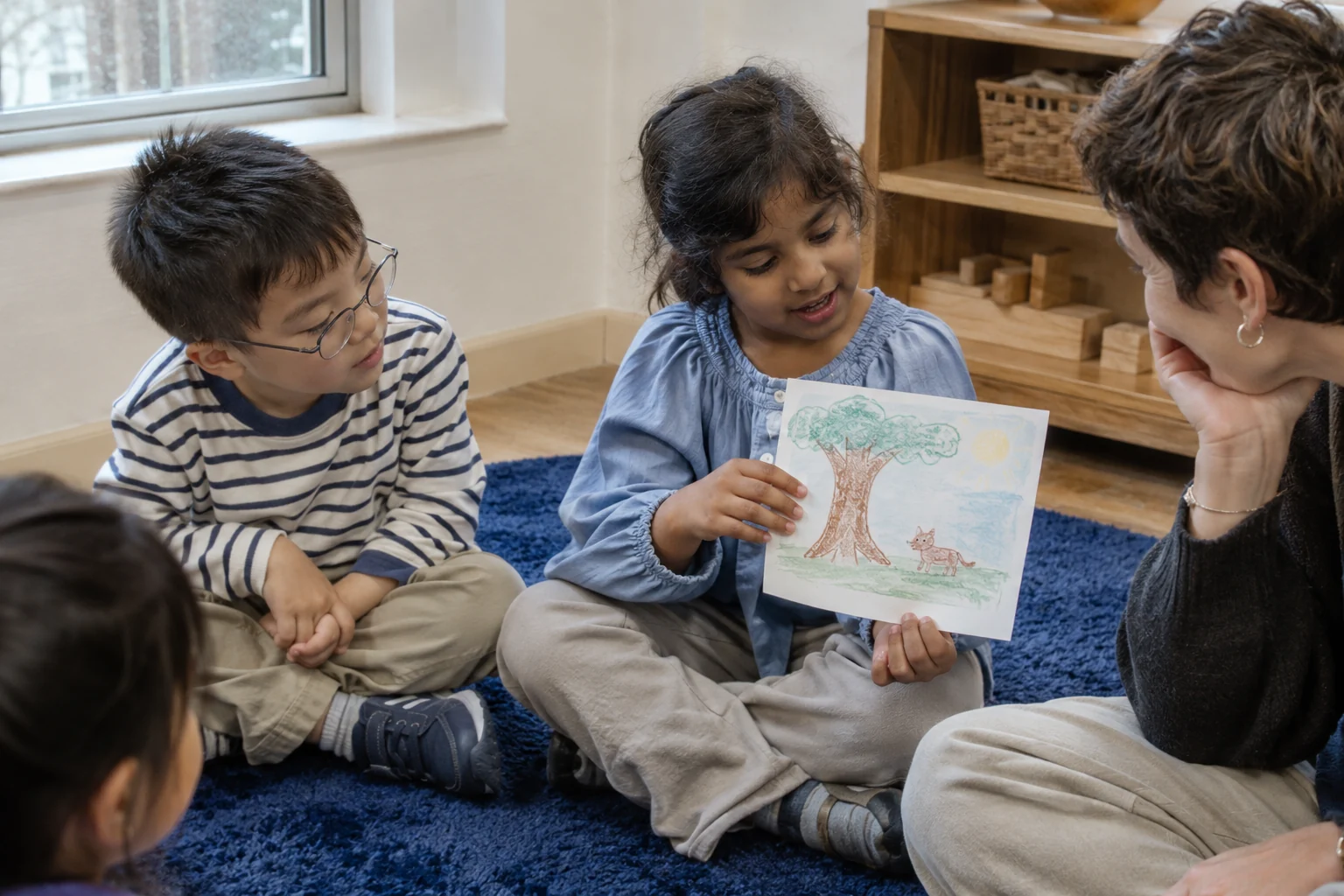
Drawing in the mind, Mental imageryChildren bring a heard story to mind as images, draw it, and express it through movement.
Combining and expanding, The 3 tools of words · Spiral learning“Big red apple!” → “I want the big red apple.” Children make longer sentences each time using the same materials.
Until it becomes automatic, OverlearningEnjoyable repetition builds basal-ganglia English until basic sentence patterns flow without conscious thought.
Telling the whole story again, RetellingChildren reconstruct a whole book in their own language from beginning to end, without lowering the original vocabulary level.
Creating one’s own story, Generative speakingThe moment several books become a 4th story