
ALTIORA's OneBite is designed to present words alongside images, sounds, and movements, while Gifted Language Schema and FluenTree guide children through whole stories as internal simulations. The deep academic basis of these activities lies in a cognitive process called mental imagery. Let us explore how it works, why early childhood matters, and how it benefits development.
Quietly bring the words “the sound of rain” to mind. What appears? Some of you may first hear rain falling on a roof; others may sense the smell of soil after rain. Some may recall an afternoon looking out a window, or even the face of someone who was there in that scene.
Cognitive psychology calls this small internal activity mental imagery. When we hear words, read sentences, or follow stories, we picture things in our minds, a process that brings not only sights but sounds, movements, emotions, and contexts to life internally. Mental imagery was long considered merely a byproduct of imagination. Over the past 50 or so years, however, cognitive psychology and neuroscience have clearly shown it to be one of the most important cognitive mechanisms in human learning, memory, and comprehension. Early childhood is precisely when this mechanism forms most actively.
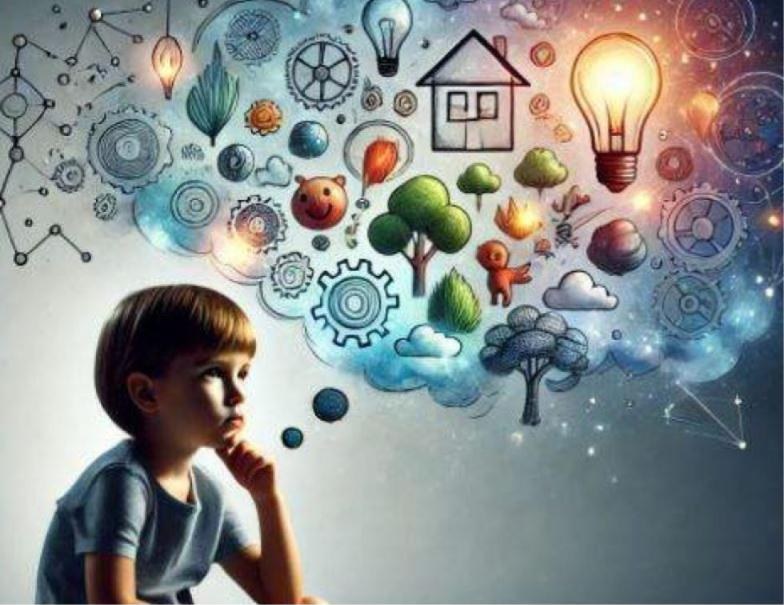
1. Mental pictures use the same brain systems as actually seeing
Neuroscience has most clearly shown that this is more than simple imagination. Through fMRI brain imaging, American cognitive neuroscientist Stephen Kosslyn consistently demonstrated that the visual cortex activated when people see a scene is activated in almost the same way when they close their eyes and imagine it. The imagined scene of rainfall and the rainy view outside a window are not fundamentally different in where the brain processes them.
The implication is clear. Mental imagery is not a weak copy of real experience. It is the brain reliving experience. A child imagining a scene is performing neurological activity of the same kind as actually seeing it. This neurological equivalence explains the cognitive power of imagery. When we can picture something vividly, the brain processes and stores the information as if it were an actual experience.
2. Dual coding: When pictures and words are stored together
Canadian cognitive psychologist Allan Paivio's Dual Coding Theory provides the most systematic account of imagery's cognitive benefits. Paivio showed that humans store information through two independent channels. One is verbal, storing the sounds and forms of words. The other is nonverbal, storing images, sensations, and actions. The channels function independently but are interconnected, so activating one also activates the other.
The theory has consistently demonstrated a clear finding: when the same information is stored through both channels, memory is stronger and retrieval faster. People who imagine a word with an image remember it better than those who memorize the word alone; those who picture a sentence in their minds understand it more deeply than those who merely read it.
Follow-up research by Mark Sadoski and Paivio applied this theory to education. Their consistent finding was that learning in vocabulary and content comprehension improves markedly when learners hear or read words and sentences and convert them into mental images. This is not simply a matter of study technique; the effect is grounded in human cognition's underlying two-channel organization.
3. Listening to a story is seeing it in the mind
Another crucial function of imagery appears in story comprehension. Listening to or reading a story is not merely following words. Skilled readers and listeners build a stage in their minds as a story unfolds. What the characters look like, where they stand, what they do, and the atmosphere of the setting are all simulated mentally.
Situation model theory, developed by American cognitive psychologist Rolf Zwaan and colleagues, traces this process precisely. Their consistent finding is that understanding a story is not merely processing word meanings, but mentally simulating the situations those words refer to.
People who understand stories well are good at simulation. The richer the internal work of vividly picturing a story's spaces, following characters' movements, tracking time, and constructing causal relationships, the deeper the information gained from the story.
This does not simply mean having a rich imagination. It means that understanding a story is inherently an act of mental imagery.
4. Early childhood is a time of rapid growth in mental imagery
Mental imagery is a developing ability rather than an innate one. Developmental psychology has consistently shown that children's imagery becomes rapidly more sophisticated around ages 4–5. At this time, children quickly develop the ability to imagine objects not present, picture scenes they have not experienced, and mentally simulate events in stories.
American educational psychologist Michael Pressley consistently studied imagery-strategy training with children at this stage. His findings were clear: from around age 5, children guided to make mental pictures while listening to stories showed markedly improved story recall and comprehension. The effects of this training were not one-off, but accumulated with repetition and became habits. In other words, imagery is an ability that develops in early childhood and can also be cultivated most effectively then. This is more than the development of imagination. It is the development of internal simulation abilities underlying all subsequent learning, reading comprehension, vocabulary expansion, abstract thinking, and creative expression.
5. Environments that develop mental imagery
Mental imagery does not develop at the same pace in every child. The experiences accumulated make a decisive difference. Research consistently points to the following conditions for an imagery-rich environment.
- Picture-book experiences rich in images Experiences in which children encounter text and pictures together, naturally connecting stories and visual representations
- Experiences of words alongside the senses Encountering words with sounds, movements, images, and contexts rather than through definitions alone
- Guidance to listen to stories and imagine them Experiences in which adults ask “What might that scene look like?” and children put the scenes in their minds into words.
- Re-expressing personal experiences through words and images Drawing what they have seen and done, and reconstructing it in speech.
As these experiences accumulate, children's minds become rich stages across which words, images, and sensations move freely. On those stages, their thinking grows deeper and richer.
Mental imagery in early childhood education is not an optional learning strategy. It is cognitive infrastructure underlying all language learning, all story comprehension, and all development of thinking.