
What is DAP?
DAP (Developmentally Appropriate Practice) is a central principle of early childhood education established by NAEYC. It is an approach to designing education that considers children's developmental stages, individual characteristics, and the contexts of their lives. NAEYC defines DAP as practices that promote each child's optimal development and learning through strengths-based, play-based approaches.
DAP also emphasizes designing environments that develop children's potential across all developmental domains and areas of educational content without harming their physical, cognitive, social, or emotional well-being. It does not simply mean “teach young children easy things.” Rather, it is professional educational judgment that draws on a deep understanding of a child's development to offer the most meaningful experiences the child can take on now.
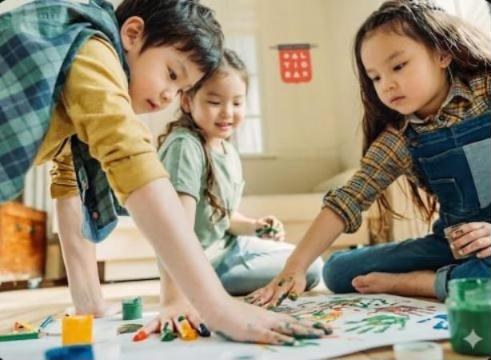
The three considerations of DAP: Commonality, individuality, and context
DAP operates through three considerations. First is commonality: understanding typical developmental patterns within an age group. Second is individuality: even children of the same age differ in interests, strengths, language experiences, emotional characteristics, and learning pace. Third is context: because children grow within families, cultures, languages, and communities, education must connect with their actual living environments. NAEYC explains that commonality, individuality, and context should inform every decision made by early childhood educators.
These considerations closely align with ALTIORA's timely education. We design curricula reflecting the developmental characteristics of ages 3, 4, and 5, while allowing each child's distinct strengths and potential to unfold richly. Timely education at ALTIORA therefore aims for “more appropriate,” not “faster.”
Developmental appropriateness means precise alignment, not lowering the level
Developmental appropriateness is not about lowering educational standards. It means avoiding excessive advancement and fragmented achievement-focused teaching that do not suit development, and carefully designing learning in ways children can genuinely understand, experience, and express.
Young children learn more deeply through movement, sensory experience, play, stories, and relationships than through abstract explanations. Good early childhood education should therefore consist of integrated experiences of listening, looking, touching, moving, speaking, making, and expressing again, rather than injecting knowledge through fragmented subjects. NAEYC likewise explains that development and learning are dynamic processes in which biological characteristics and environment influence one another, and that high-quality early learning experiences significantly affect later development and learning.
From this perspective, ALTIORA organizes learning through sensory experience, meaning connections, structuring, generation, and expression. Children first experience the world fully, connect those experiences with their thoughts and feelings, structure them mentally, create new ideas, and express them through speech, writing, pictures, gestures, and creations. Rather than fragmented study, this lets children experience the entire process of receiving the world, thinking, and expressing within a developmental model.
Play-centered education is not a hands-off approach
Play matters in DAP because it is the most natural way young children learn. In play, children create rules, change roles, negotiate with friends, solve problems, and express what they imagine. Play brings together language, social skills, emotional regulation, physical movement, mathematical thinking, and scientific inquiry.
Korea's revised 2019 Nuri Curriculum also offers explanatory guides and resources for educators to support understanding and practice of a child- and play-centered curriculum. This reflects a movement to regard play as central to learning rather than simply a break. This is also why ALTIORA values play. Our play is not purposeless activity, but an educational setting that helps children explore developmentally needed experiences in their own ways, extend them through relationships, and express them through varied languages.
Whole-child development: Children do not grow in just one domain
Another central emphasis of DAP is the integration of developmental domains. Young children's language does not grow in isolation, nor do cognition or social skills. Physical movement influences self-regulation and attention, interactions with friends encourage language and emotional development, and listening to picture books develops imagination, literacy, and empathy together.
Early learning involves more than cognition. Every moment of moving the body, forming relationships, regulating emotions, and exploring nature is a learning moment. ALTIORA therefore integrates its curriculum so that physical, emotional, social, cognitive, and linguistic development grow together in a single flow.
The teacher's role in DAP
In developmentally appropriate education, teachers do more than deliver knowledge. They observe children, recognize their current developmental levels and interests, and adjust environments and language to help them move into their next experiences. DAP places great importance on professional judgment because the same activity may offer sufficient exploration for one child while requiring more linguistic scaffolding for another.
This is also why ALTIORA describes teachers' language as “questioning and listening” rather than “directing and evaluating.” Scaffolding that advances children's thinking is not giving answers for them; it is sensitive educational support that helps them discover and express in their own ways.
Good early childhood education follows the child's developmental clock
DAP reaffirms the most fundamental standard that early childhood education should follow. Children are not merely small, immature learners; they already possess strengths and possibilities. Good education does not hastily draw those possibilities out, but provides the richest experiences at the most appropriate time and in the most appropriate ways.
ALTIORA's education also rests on this principle. It is an integrated developmental curriculum that helps young children play fully, think deeply, and express freely in time with their own developmental clocks. Every child's giftedness awakens through developmentally appropriate environments and experiences. That careful design is the very essence of early childhood education.