
Imagine someone has 1,000 English words stored in their mind. Yet when meeting someone from another country, they can recall fewer than 100 of them. A word they answered correctly on a test rarely comes readily to their lips in an actual conversation. This is not laziness or inadequacy. Memorized words and experienced words are fundamentally different.
Over recent decades, cognitive neuroscience and developmental psychology have revealed this difference with increasing clarity. Together, their findings converge on a proposition: “Words are experienced, not simply memorized.”
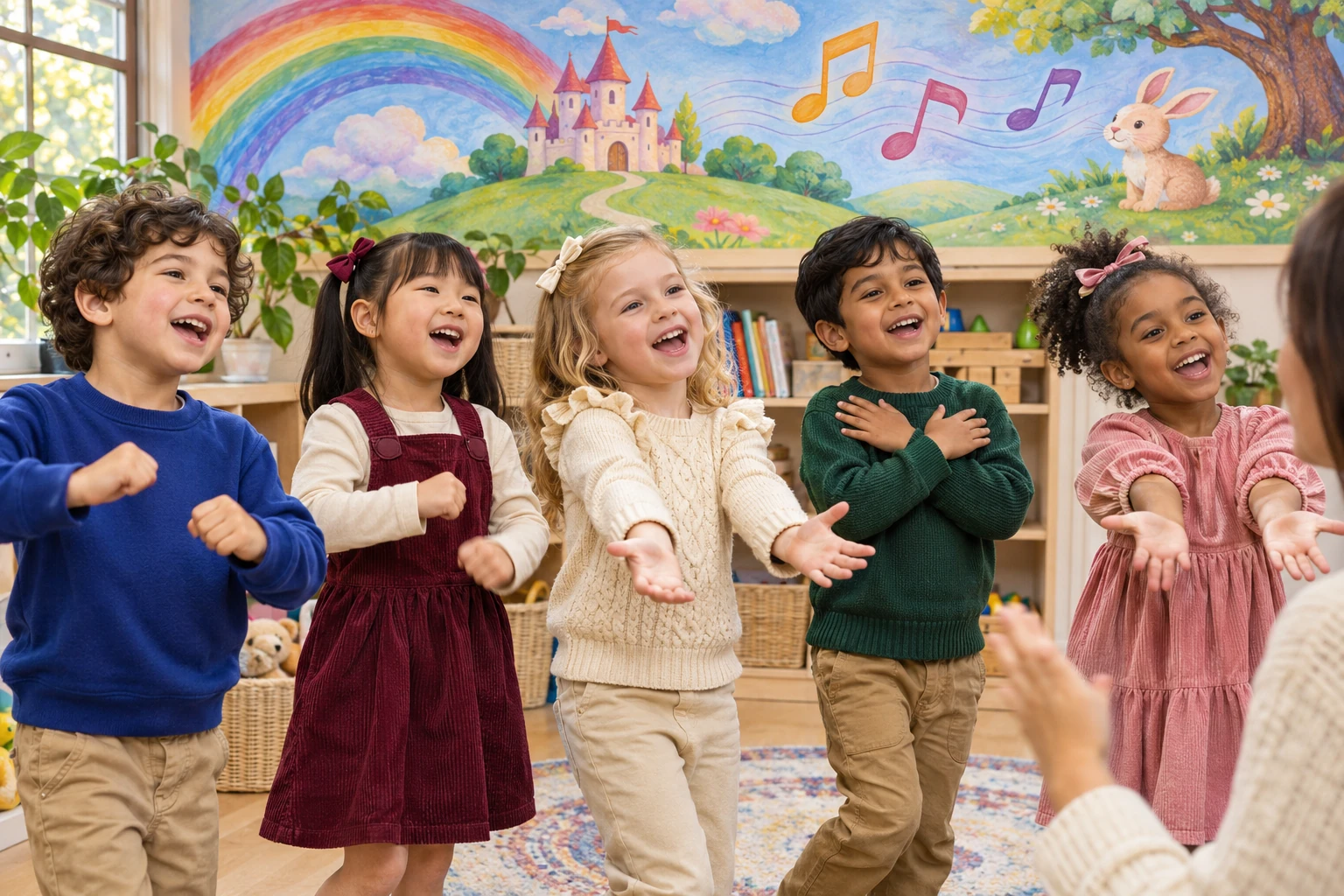
Image caption: During ALTIORA's vocabulary-thinking program OneBite, children experience words through every channel of seeing, hearing, moving, feeling, and imagining.
How words live in the brain
We have long assumed that words are abstract symbols: that the letters apple are an arbitrary sign for the concept of an apple, stored somewhere in the brain like an entry in a dictionary. But 21st-century neuroscience has made clear that this assumption does not match reality.
German cognitive neuroscientist Friedemann Pulvermüller demonstrated a remarkable finding through fMRI brain imaging. Merely reading kick activates the brain's leg movement area; reading lick activates the tongue movement area; and reading pick activates the finger movement area. Reading a word, in other words, triggers a simulation of the bodily action it refers to. This shows that words are not stored as abstract symbols alone. They are neurologically connected with traces of the experiences they denote, and each time a word is processed, those traces are activated with it.
American cognitive psychologist Lawrence Barsalou calls this grounded cognition, developing a theoretical account in which all human concepts fundamentally rest on simulations of sensory and motor experiences. The implication is simple: words are inherently shaped by experience. A word memorized without experience therefore cannot be received by the brain as a living word.
How children acquire words
This becomes even clearer when we look at children's natural vocabulary development.
Developmental psychologist Michael Tomasello consistently showed that infants and young children acquire words not by learning definitions, but through experiences of use within joint attention. Children do not learn “ball” by being given a definition of a ball. They acquire the word through accumulated experiences of adults pointing to balls, rolling balls together, and talking about them.
Research by developmental psychologists Linda Smith and Chen Yu at Indiana University tracks this process more precisely. Children do not learn a word from a single teaching episode. They detect statistical regularities as the same word repeatedly occurs with the same referent across situations and extract its meaning. This is called cross-situational statistical learning. In other words, the way children acquire words differs fundamentally from memorizing word cards. Children repeatedly experience words in multiple contexts, through multiple senses, and in interactions with multiple people. Only words experienced in this way become part of their vocabulary.
Why memorized words disappear
Bringing these two lines of research together reveals why memorized words disappear over time.
Memorized words are stored as isolated information. Only the word's sound and its Korean translation are connected; there are no sensory traces, movement memories, situational contexts, or faces of people to become active alongside it. The brain does not preserve isolated information well. Memories that are unused and unconnected to other information are quickly pruned. When we feel we are forgetting memorized words, the brain is actually naturally clearing away information that is not alive.
Experienced words, by contrast, become part of connected information networks. Each time a word is recalled, sensations, movements, situations, emotions, and relationships activate alongside it. The richer this network, the more firmly the word is retained, the faster it is retrieved, and the more richly it is used. This is why vocabulary education in early childhood should take place through experience rather than word cards.
The questions vocabulary education must ask again
These findings pose clear questions for vocabulary education. Before asking how many words we have taught, we should ask which of the child's experiences each word connects with. Before measuring how quickly children memorized, we should examine how deeply they experienced.
Good vocabulary education is not about increasing the number of words. It is about giving depth to the experience of each word. Hearing the same word in a song, seeing it in a picture, expressing it in movement, reusing it in play with friends, and encountering it again in a picture-book scene are repeated experiences whose layers turn words into living vocabulary.