
Experiences with stories are very important in early childhood. Fiction picture books and story activities help children follow characters' feelings, understand the course of events, and experience emotions and imagination richly. Stories are powerful tools that bring children's speech and thinking to life.
Experiences with information about the real world broaden children's language in another direction. While stories invite children to follow “what happened” and “how the character felt,” informational topics invite them to consider “what it is,” “what characteristics it has,” “how it changes,” and “why it happens.”
These two experiences can be seen not as competing areas but as two dimensions that enrich language and thought in different ways. Story experiences develop language for emotion, imagination, and understanding events, while informational experiences develop language for expressing observation, comparison, classification, sequence, and cause and effect.
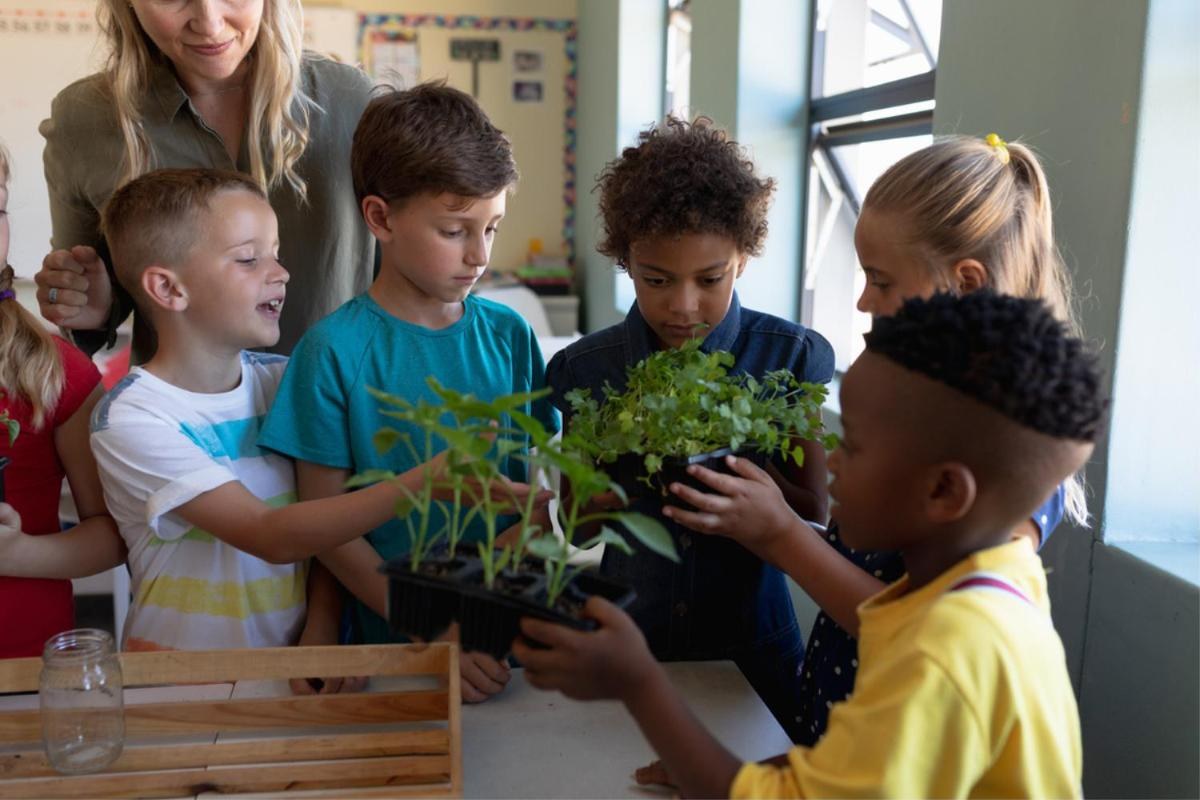
The real world is the child's nearest setting for inquiry
Children encounter the real world every day: the air on a rainy day, soil changing color when a pot is watered, the shapes and colors of leaves, ants moving in a line, and small promises kept with friends. Such scenes offer important clues for understanding the world.
For young children, topics such as animals, plants, the body, weather, family, homes, neighborhoods, and nature are part of their immediate lived world rather than distant knowledge. Through these topics, children look more closely at the world they inhabit. Questions such as how seeds grow, why animals live in different places, how rain falls, how our bodies move, and how people live together deepen their observations. Starting with learning names, they examine characteristics, observe processes of change, consider necessary conditions, and connect relationships between one scene and another.
Informational experiences extend children's speech into explanatory language
Children's speech grows with their everyday experiences. It may begin with names such as “rain,” “leaf,” “bird,” and “seed.” It then moves to characteristics such as “It's wet,” “It's green,” “It's small,” and “It flies away,” gradually expanding into language with relationships and reasons: “It needs water,” “It grows when it gets sunlight,” and “The nest protects the eggs.”
Informational experiences introduce language for explaining the world: language for describing observations, comparing similarities and differences, recalling sequences, and connecting causes and effects.
This kind of speaking can begin naturally even in early childhood. Rather than explaining difficult concepts, children discuss “what they saw,” “what changed,” and “why it happened,” focusing on scenes they have seen themselves and familiar topics. Explaining in their own words helps children organize their thinking.
Systematic topic experiences broaden children's worlds
Informational experiences can begin with chance discoveries. At the same time, encountering a balanced range of real-world topics within a curriculum broadens the world children see. Topics such as self and body, family and relationships, homes and neighborhoods, animals and plants, weather and seasons, tools and daily life, and Earth and nature connect with children's everyday lives. When these topics are offered repeatedly and systematically, children encounter similar questions in various contexts and can gradually become familiar with ways of observing and expressing.
The IB PYP guides students to expand conceptual understanding, knowledge, and skills across subject boundaries through six transdisciplinary themes. The six themes presented by the IB are Who we are, Where we are in place and time, How we express ourselves, How the world works, How we organize ourselves, and Sharing the planet. These broad themes can also be made accessible to young children. When expressed as questions such as “What kind of person am I?”, “What are our family and neighborhood like?”, “How do people express their feelings?”, “How do rain and wind arise?”, “Why do we make rules?”, and “How do animals and plants live alongside us?”, broad themes become inquiries within children's everyday lives.
Informational experiences provide a background for literacy
The ability to understand text relates not only to decoding but also to vocabulary, oral language comprehension, background knowledge, and breadth of experience. The National Early Literacy Panel's comprehensive report found that early literacy elements including oral language, vocabulary, background knowledge, and phonological awareness are related to later reading development.
For example, when a child encounters the sentence “A seed sprouts,” having seen seeds, understanding the roles of soil, water, and sunlight, and observing plants grow over time enrich the sentence's meaning. From this perspective, informational experiences in early childhood can provide a semantic background for later literacy development. Even before reading print, children build a foundation for understanding sentences by observing the real world, connecting meaning, and expressing it in words.
English expression also needs meaningful content
Unlike environments in which English is used extensively in daily life, children in EFL settings often first encounter English as individual words or sentences. Familiar real-world topics can then give their English expression meaningful content.
If children have observed plant growth, discussed changes in weather, compared animals' habitats, and understood how their bodies move, English expression can have a more vivid context. When children have content they understand, English can serve as a tool for expressing it.
These experiences help extend English speaking beyond simple repetition into expression with content. Children try saying in English what they have seen, learned, and become curious about, experiencing language as a tool for exploration and expression.
The experiences ALTIORA PYP adds
ALTIORA's various programs enrich children's emotions, imagination, and communication experiences through picture books and story activities. ALTIORA PYP adds informational experiences that bring children into contact with the real world in diverse ways.
Through familiar topics, children look, listen, observe, question, and express themselves. They encounter related information within a topic through pictures and sounds, conversations and activities, and try expressing what they understand in their own words. The fact that all this also takes place from the perspective of acquiring and using English adds another dimension: children experience English as a language for expressing the world they have explored.
ALTIORA PYP organizes real-world informational experiences at a level suited to young children. Through varied topics, it creates opportunities to see the world a little more clearly, express what they have learned in their own words, and speak meaningfully in English as well.
Informational experiences in early childhood build a small map within children for understanding the world. That map can become an important background for reading books, writing, asking questions, presenting, and expressing thoughts in a new language later on. Rather than children who merely know a lot of information, we envision children who are curious about the world and seek to understand it. To support growth in that direction, ALTIORA PYP designs real-world informational experiences suited to children's developmental stages.